


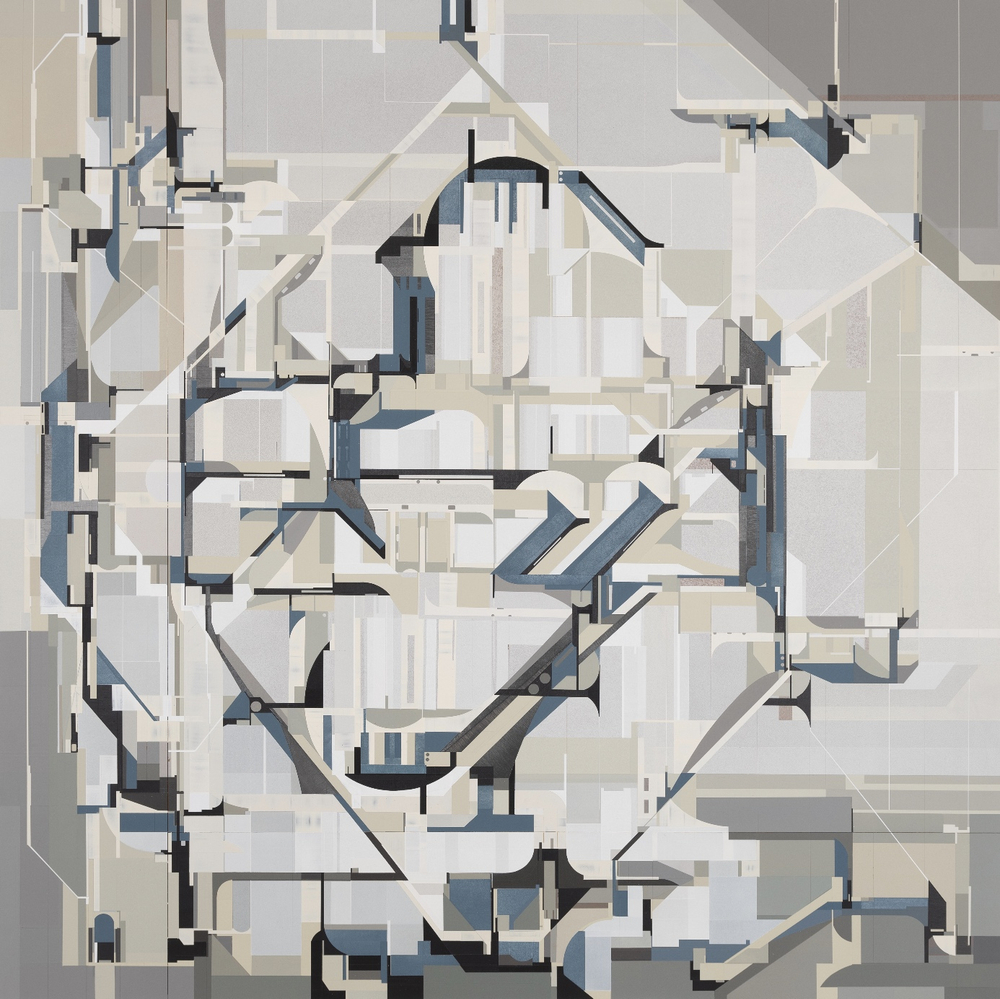
SPACES FOR THE MIND AND EYE
Line, gesture, and geometry coalesce in dynamic visual harmonies in painter James Kennedy’s exhibition, Spaces for the Mind and Eye, at Callan Contemporary. Titled after a thought-provoking profile of Kennedy in the March 2026 issue of AD Design, the show highlights his masterful integration of art-historical influences such as Futurism, Abstract Expressionism, the paintings of Ben Nicholson, and the architectonics of Le Corbusier—all channeled through the prism of his own singular aesthetic viewpoint. To create his elegant abstractions on eucalyptus Masonite panel, Kennedy applies as many as 100 translucent acrylic washes over a gesso base, selectively incorporating pumice, graphite, modeling- paste extender, and micaceous iron oxide in layers so topographical, they often cast subtle shadows. This haptic, organic quality, contextualized within an organizing principle of order and balance, has origins in his interdisciplinary background across the fine arts, theater, dance, and design. The paintings that result from these meticulous processes are not only optically alluring, but visceral, almost corporeal.
Born in Northern Ireland, now based in upstate New York, Kennedy earned degrees from the Royal Scottish Academy (Glasgow), London School of Contemporary Dance, and Rhodec Design Academy (Brighton). His works are included in the permanent collections of The British Museum, Saatchi & Saatchi, Corcoran Group, Nordstrom, St. Regis Hotels, The Waldorf Astoria, and the estate of Pulitzer Prize-winning playwright Edward Albee. The subject of the solo exhibition James Kennedy: Shape-Shifting at John Hartell Gallery (Cornell University), he is renowned for his instantly recognizable syntax of interconnected forms, which relate to one another in a spirited dialogue between foreground, background, expansiveness, and density, always arriving at a spatial resolution at once immaculate and inevitable.
“I create connections between the forms and a landscape in which they sit,” the artist observes, likening aspects of his compositions to “overhead shots of a choreographic space.” He compares these interwoven elements to “a duet between two dancers, where one body supports the other body.” Perfectly braced and ballasted across the picture plane, the forms, along with the connections that link them, engage one another—and the viewer—in a complex, invigorating pas de deux.
- Richard Speer